8.6%
historical average shelf out-of-stock rate in Europe
An ECR synthesis of more than 50 FMCG studies.
ECR Europe / Corsten & GruenRetail economics
Start with credible sector benchmarks, replace the assumptions with your own operating data, then validate the opportunity through a focused store pilot.
Benchmarks, transparent model, pilot measurement
Business impact
ShelfGuide connects shelf visibility to the outcomes retail leaders measure: protected sales, field productivity and controlled execution risk.
8.6%
An ECR synthesis of more than 50 FMCG studies.
ECR Europe / Corsten & Gruen43%
Through abandonment, another store or a lower-value substitution.
ECR Retail Loss+0.20–0.35%
An industry experience range; actual results vary by retailer.
McKinsey, 2024Up to 4h
A sector benchmark, not a claimed ShelfGuide customer result.
McKinsey, 2020Find empty, low-stock or misplaced positions while teams can still act on them.
Merchandisers and regional managers work from prioritized exceptions instead of searching aisle by aisle.
Create timestamped evidence, assign corrective work and verify that each issue is closed.
Your own assumptions
Use store count, audit volume and monthly sales to build a transparent scenario in MAD.
Open the impact simulatorIndustry benchmarks are provided for context. They are not ShelfGuide performance guarantees; results must be validated in a pilot.
Impact simulator
Replace the illustrative inputs with your own data. The model keeps team capacity and sales opportunity separate so the result stays readable and honest.
Illustrative starting point — replace with your data
Modeled monthly opportunity
Calculated from your assumptions
Audits analyzed
108
Team hours released
36.1 h
Capacity value
1,625 MAD
Potential sales range
10,000–17,500 MAD
Uses McKinsey’s 0.20–0.35% sales range for each one-point in-stock improvement.
View benchmark methodologyIllustrative scenario only. Released hours become savings only when capacity is reallocated or cost is avoided. Potential sales are neither profit nor guaranteed revenue. Validate the assumptions through a pilot.
Discuss this scenarioProduct vision · in development
The ShelfGuide robot is being developed as a new capture layer for the same AI engine: move through aisles, observe shelves and send prioritized actions to store teams.
It does not replace teams. It automates the search for anomalies so people can spend more time correcting, advising and serving shoppers.
A team member captures a shelf and receives structured issues and actions.
Standardize routes, coverage and recurring controls across stores.
Continuous capture and synchronization with the ShelfGuide action platform.
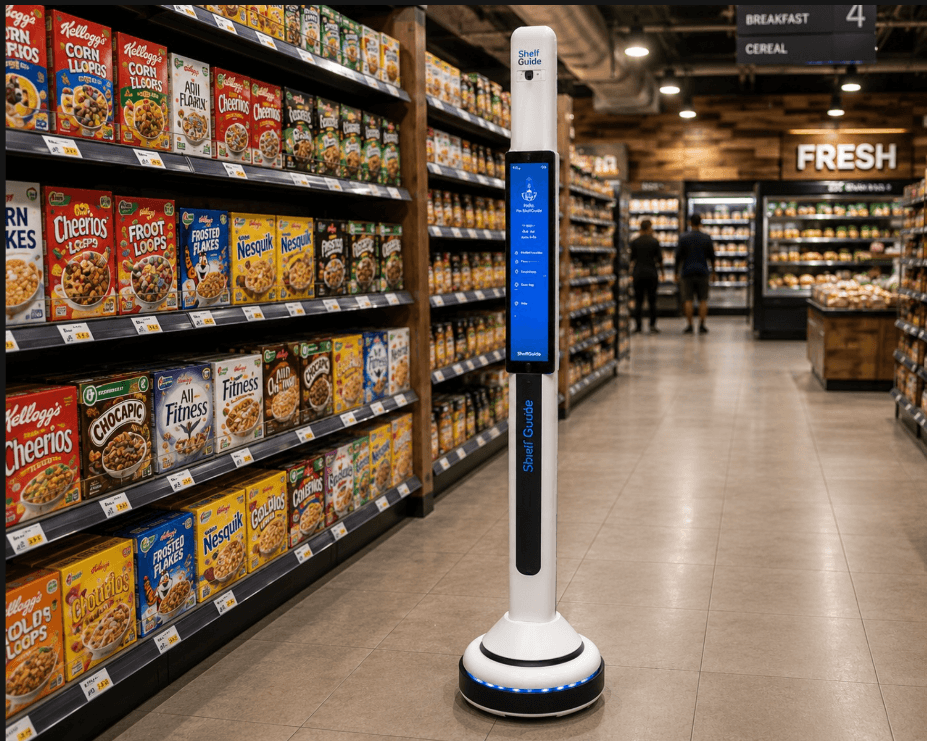
Concept visual — design, capabilities and availability may evolve.
One intelligence layer, two capture modes
Computer vision analyzes the same shelf signals.
Exceptions enter the same prioritized action queue.
Managers keep one network view across mobile and autonomous audits.
Describe your network, audit volume or biggest shelf challenge. The assistant covers product, impact, limitations and rollout questions.
Product, impact and roadmap knowledge
Pilot ready
From one photo, detect stock gaps and execution issues instantly. Your teams act faster, and your stores stay on track.

Shelf Score
Demonstration scenario · 76% · 4 priority alerts